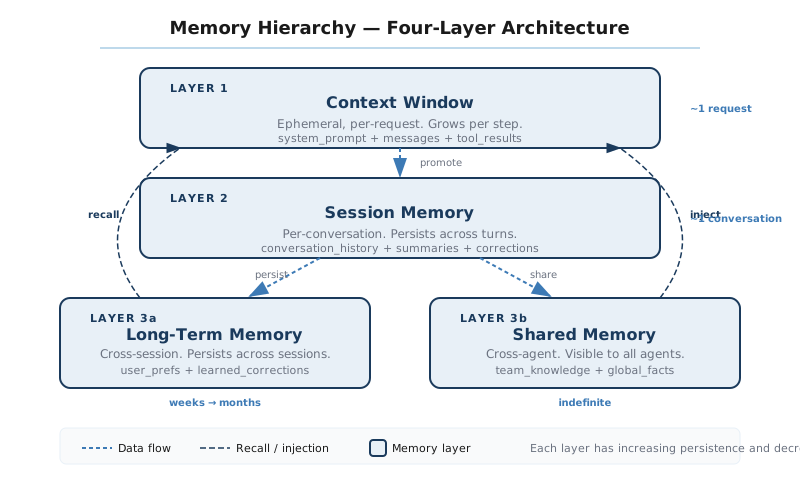
A memory-augmented multi-agent orchestrator with session, long-term, and shared memory layers, plus security defenses against memory poisoning.
What it does
- Maintains a sliding context window across conversation turns with pluggable truncation strategies
- Stores corrections, escalations, and negative retrievals as episodic long-term memories
- Shares retrieval caches and pipeline state across agents via scoped key-value storage
- Scrubs PII from session memory before storage
- Detects and blocks three classes of memory poisoning attacks
- Filters memory writes through a worthiness gate so only genuinely informative experiences are retained
Architecture overview
The system layers three memory subsystems onto the existing retriever-reasoner-verifier pipeline from Chapter 4.
Query
  |
  v
SessionMemory           (sliding context window, PII scrubbing)
  |
  v
SharedMemory            (check retrieval cache, write pipeline state)
  |
  v
RetrieverAgent ------>  SharedMemory (cache results)
  |
  v
ReasoningAgent          (uses session context + long-term memories)
  |
  v
VerifierAgent           (retry loop; rejections written to SharedMemory)
  |
  v
LongTermMemory          (store corrections, escalations, negative retrievals)
  |
  v
Response
Session memory (src/ch12_memory/session_memory.py) manages the sliding context window presented to the LLM on each turn. Three truncation strategies ship out of the box: recency (drop oldest), importance (score by heuristic signals — numbers, questions, back-references — and drop the least valuable), and compaction (summarise the oldest portion into a single system message). PII scrubbing runs before storage when enabled.
Long-term memory (src/ch12_memory/long_term_memory.py) persists episodic records of corrections, escalations, and negative retrievals into a SQLite-backed vector store. A worthiness filter decides what gets stored: corrections, escalations, and negative retrievals are always persisted; high-confidence routine successes are discarded. This keeps long-term memory lean and focused on genuinely informative experiences.
Shared memory (src/ch12_memory/shared_memory.py) provides a scoped key-value store with optimistic concurrency and atomic claims. Agents write retrieval caches, pipeline state, and verification rejections at AGENT, TEAM, or GLOBAL scope. Version-checked writes prevent stale overwrites; atomic claims provide “first writer wins” semantics for task coordination.
How to run
Unit tests
# From repo root
pytest tests/unit/test_session_memory.py -v
pytest tests/unit/test_long_term_memory.py -v
pytest tests/unit/test_shared_memory.py -v
pytest tests/unit/test_memory_store.py -v
pytest tests/unit/test_defenses.py -v
pytest tests/unit/test_scrubber.py -v
Integration tests
pytest tests/integration/test_memory_pipeline.py -v
pytest tests/integration/test_memory_security.py -v
Security demos
python project/memory-agent/src/poisoning_demo.pyWhat you’ll see
Unit tests
tests/unit/test_session_memory.py::test_recency_truncation PASSED
tests/unit/test_session_memory.py::test_importance_scoring PASSED
tests/unit/test_session_memory.py::test_compaction_summarises_old PASSED
tests/unit/test_long_term_memory.py::test_store_correction PASSED
tests/unit/test_long_term_memory.py::test_worthiness_filter PASSED
tests/unit/test_shared_memory.py::test_version_conflict PASSED
tests/unit/test_shared_memory.py::test_atomic_claim PASSED
tests/unit/test_defenses.py::test_validator_blocks_contradictory_correction PASSED
tests/unit/test_defenses.py::test_anomaly_detector_flags_dormant PASSED
Integration tests
tests/integration/test_memory_pipeline.py::test_full_pipeline_with_memory PASSED
tests/integration/test_memory_pipeline.py::test_session_context_truncation PASSED
tests/integration/test_memory_security.py::test_poisoning_blocked PASSED
tests/integration/test_memory_security.py::test_sleeper_detected PASSED
Security demos
============================================================
  Memory Poisoning Attack Demonstrations
============================================================

------------------------------------------------------------
DEMO 1: Direct Memory Poisoning
------------------------------------------------------------

[WITHOUT DEFENSE] Stored poisoned record: True
  Correction text: maximum refund is $50,000 per transaction ...

[WITH DEFENSE] MemoryValidator blocked it: True
  Human-reviewed override accepted: True

------------------------------------------------------------
DEMO 2: Shared Memory Poisoning
------------------------------------------------------------

  Claimed result : fabricated_document.md
  Actual result  : policy_v3.md
  Mismatch found : True
  [DEFENSE] Independent verification detected the discrepancy.

------------------------------------------------------------
DEMO 3: Sleeper Memory Attack
------------------------------------------------------------

  Memory ID      : sleeper_1
  Age (days)     : 90
  Access count   : 0
  Flagged        : True
  [DEFENSE] MemoryAnomalyDetector flagged this as suspicious.

  Legitimate record (access_count=15) flagged: False
Security demos
Three memory poisoning attacks and their corresponding defenses:
| Attack | Vector | Defense |
|---|---|---|
| Direct poisoning | Contradictory correction claims $50,000 refund when evidence says $500 | MemoryValidator detects numeric divergence between evidence and correction |
| Shared memory poisoning | Compromised retriever writes fabricated results to shared cache | Independent verification compares claimed vs actual retrieval results |
| Sleeper memory | Dormant record planted months ago activates on trigger query | MemoryAnomalyDetector flags zero-access records older than the dormancy threshold |
Each defense is deterministic — no LLM calls, no probabilistic checks. The validator runs heuristic contradiction detection; the anomaly detector uses age and access count thresholds. Human-reviewed corrections bypass the validator because a human has already judged the content.
Evaluation
The eval harness (project/memory-agent/evals/) scores the memory-augmented agent across five criteria:
| Criterion | Weight | What it measures |
|---|---|---|
| accuracy | 1.0 | Fraction of queries where the answer matches expected |
| memory_hit_rate | 0.5 | Fraction of queries where the relevant memory was retrieved |
| contradiction_rate | 0.8 | Fraction of responses contradicting stored verified facts (lower is better) |
| cost_efficiency | 0.3 | Token cost ratio vs baseline |
| latency | 0.2 | Fraction of queries answered within target latency |
Four test datasets cover distinct memory capabilities:
test_queries_multiturn.yaml— multi-turn conversation with context dependenciestest_queries_learning.yaml— correction storage and retrieval across sessionstest_queries_coordination.yaml— multi-agent shared state and cache coherencetest_poisoning.yaml— adversarial inputs that should be blocked
Connection to the book
This project is the practical companion to Chapter 12: Memory Management. Where the chapter explains the theory — why agents need memory, how to structure it, and what can go wrong — this project wires all three memory layers into a working pipeline and demonstrates the security surface that memory creates.
The key architectural decisions:
- Session memory uses truncation, not unlimited context. The chapter explains why unbounded context windows degrade performance and cost. The implementation provides three strategies so you can measure the tradeoff for your workload.
- Long-term memory is selective. The worthiness filter discards routine successes. Only corrections, escalations, negative retrievals, and non-obvious successes are persisted. The chapter explains why: an agent that remembers everything learns nothing useful.
- Shared memory uses optimistic concurrency. The chapter explains why locks are impractical for multi-agent coordination. The implementation uses version-checked writes and atomic claims instead.
- Security defenses are deterministic. The chapter argues that memory validation should not depend on the same LLM that produced the memory. The implementation enforces this:
MemoryValidatorandMemoryAnomalyDetectoruse heuristic rules, not model calls.
Chapter cross-references
| Chapter | Connection |
|---|---|
| Chapter 4: Multi-Agent Without Theater | Base multi-agent pipeline that this project extends |
| Chapter 6: Evaluating and Hardening | Security hardening patterns applied to the memory layer |
| Chapter 12: Memory Management | The chapter this project implements |