
A detector answers one question about one input and returns a verdict. That is the whole job. The engineering difficulty is not writing detectors, it is making a dozen of them, built with different techniques and sourced in different ways, behave like one coherent system that a policy layer can reason about and an operator can tune.
This blueprint fixes the interface and the composition rules. ARCH-001 decided where detectors sit; this one decides what they are.
Four techniques, two sourcing models
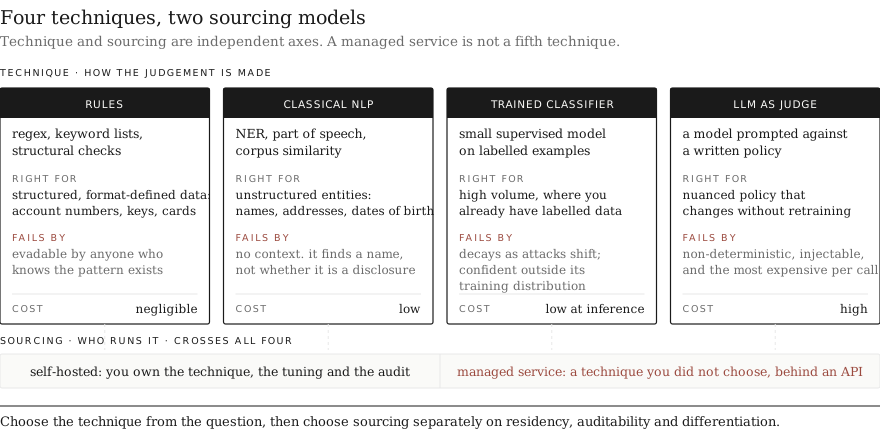
Detectors vary on two independent axes, and collapsing them into one list is a mistake that shows up later as a procurement argument. The first axis is technique: how the judgement is made. The second is sourcing: whether you run it or someone else does. A managed safety service is not a fifth technique, it is one of the four techniques with the sourcing decision already taken for you, and usually without telling you which technique it is.
Four techniques, each with a distinct cost profile and a distinct failure mode.
Rules and pattern matching. Regular expressions, keyword lists, structural checks. Negligible latency, negligible marginal cost, fully explainable, and evadable by anyone who knows the pattern exists. Correct for structured data with a defined format: account numbers, national identifiers, card numbers, API keys, base64 blobs where none should be. Wrong for anything expressed in natural language, because natural language has unbounded surface forms and your pattern list does not.
Classical NLP. Named entity recognition, part-of-speech analysis, similarity to a known corpus. Fast and cheap relative to a model call, and it generalises across surface forms in a way regex cannot. This is the right tool for unstructured personal data: names, addresses, employers, dates of birth. Its weakness is context. An NER model will find a person’s name; it will not tell you whether that name appearing in this document, retrieved by this user, is a disclosure.
Trained classifiers. A small supervised model fine-tuned on labelled examples of the thing you are detecting. Cheap at inference, and the technique whose improvement path is most direct, because the labelled set you needed to build it is the same one you tune against. Every technique here can be measured against labelled data; this is the one that cannot exist without it. Its weakness is that you need that labelled data, it decays as attacks shift, and it will confidently misclassify anything unlike its training distribution.
LLM-as-judge. A model prompted to evaluate the input against a written policy. The slowest and most expensive per call, and the most flexible in one specific sense: you can express a nuanced policy in a paragraph and change it without retraining. Three weaknesses that matter. It is non-deterministic, so the same input can produce different verdicts. It is itself susceptible to injection, because you are feeding attacker-controlled text to a model and asking it a question. And it is expensive enough that you cannot run it on every request at the prompt layer without a latency conversation.
Then the sourcing axis. Managed safety services from cloud and model vendors package one or more of the four techniques behind an API: good coverage of the commodity categories, maintained by someone else, and a real reduction in work. The costs are a network hop in the request path, a data-residency question that is not optional in a regulated environment, a model you cannot audit or tune, and a version that can change underneath you. The technique inside is usually undisclosed, which means you inherit its failure mode without being able to name it. Treat a managed service as a technique you did not choose rather than as a category of its own.
The interface contract
Every detector, regardless of family, returns the same shape. This is what lets the policy layer stay uniform and lets you swap a regex for a classifier without touching anything downstream.
DetectorResult
  detector_id       stable identifier, no version in it
  detector_version  model or ruleset version, for audit reconstruction
  threshold_version which threshold produced `band`

  execution_status  ok | error | timeout | skipped
  decision          clear | flagged | abstain  (null unless status ok)

  score             float 0..1
  score_kind        raw | calibrated  (raw: this detector only)
  band              below | near | above  (vs this detector's threshold)

  categories        list of matched risk categories
  category_schema   version of the category vocabulary
  evidence          spans or excerpts that triggered the decision
  latency_ms        observed, always recorded
  degraded          bool, true if the detector ran in a reduced mode
The shape matters more than the field names. Five decisions are encoded in it.
execution_status and decision are separate. A timeout is not a verdict. Collapsing “it did not flag” and “it did not run” into one enum is how a system silently fails open, because every downstream consumer reads the absence of a flag as safety. Keep them apart and the policy layer is forced to handle the outage case explicitly.
decision includes abstain. A detector that ran successfully and does not have enough signal to answer is telling you something real, and it is a different fact from a clear. Abstention is what lets a cheap detector defer to an expensive one without pretending to a judgement it does not have.
Version lives in its own fields, and there are three. A detector_id with a version baked into it cannot be tracked across upgrades. The detector, its threshold, and the category vocabulary all change on different cycles, and an incident review three months later needs all three to reconstruct why a given input produced a given result.
score_kind is explicit. A raw score is meaningful only within one detector. Marking it prevents the next section’s failure from happening by accident downstream.
band exists so the policy layer never sees a raw score. Policies written against raw numbers break every time you retune a threshold. Policies written against bands survive retuning, and the threshold becomes an operational parameter rather than a code change.
evidence exists because a verdict without evidence cannot be reviewed. A human deciding whether to override a block needs the span that triggered it, and a false positive analysis with no evidence field is a spreadsheet of numbers that nobody can diagnose.
degraded exists because a detector that fell back to a cheaper path did not answer the same question, and pretending otherwise silently changes your risk posture during exactly the incidents where it matters.
The calibration trap
Here is a failure that is easy to build and hard to see afterwards.
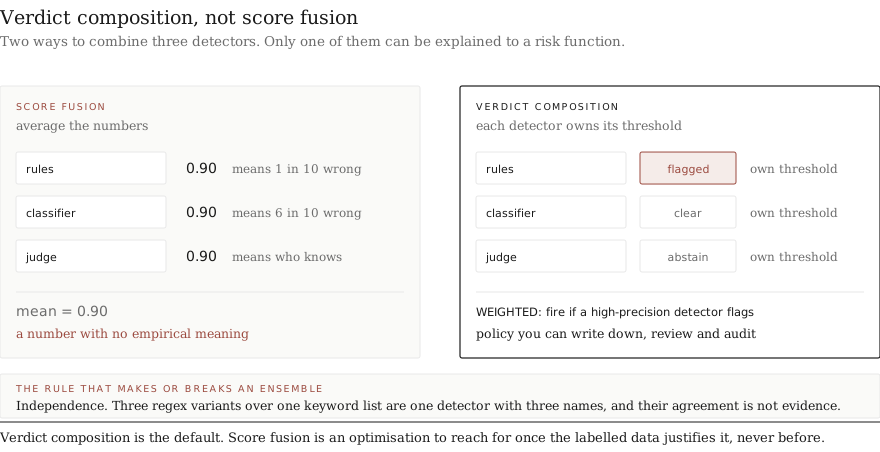
A regex returns confidence 1.0 when it matches, because it either matched or it did not. That number describes the match, not the likelihood that the match was the thing you cared about: a sixteen-digit internal reference will trip a card-number pattern with exactly the same 1.0. A trained classifier returns 0.9 as an approximately calibrated probability. An LLM judge asked to rate severity out of ten returns 9, which is a sampled token and not a probability at all.
Then someone builds an ensemble that averages them, or takes the maximum, or sums them with weights.
The number 0.9 means three unrelated things depending on which detector emitted it. Averaging them produces a value that means nothing, on a scale nobody can reason about.
The system that results has a behaviour no one can predict from first principles and no one can tune, because moving the global threshold changes the effective sensitivity of each family by a different and unknown amount. Teams then discover empirically that 0.72 “works” and freeze it, and the number becomes folklore.
Measured, the granularity problem is concrete. In Lab-007, three local models asked for a probability between 0 and 1 about the same fifty inputs used three, four and six distinct values, putting 88 to 90 percent of their answers at exactly 0.0 or 1.0.
A calibration map can still attach an empirical rate to each of those values, so this is not a detector you cannot calibrate. What calibration cannot do is recover a distinction the detector never made. Every input that scored 1.0 receives the same calibrated probability, however different those inputs were, and no amount of held-out data changes that.
A single-call ablation locates the loss in the readout rather than in the model or the prompt. Asked one Yes or No question at temperature 0, llama3.2:3b emitted “No” for all fifty inputs, which ranks at chance. The probability mass on Yes against Yes plus No, taken from that same forward pass, ranked all fifty correctly. One prompt, one call, two ways of reading one token.
The operating consequence comes first: changing a detector’s readout changes its score contract, so thresholds must be revalidated. In that measurement the recovered scores averaged 0.106 on positives and 0.007 on negatives, so ranking was perfect while a 0.5 threshold caught nothing. Put the prompt and the score-extraction method inside detector_version and treat a readout change as a detector change.
Where a runtime exposes token probabilities, normalising the affirmative token’s mass against affirmative plus negative is worth evaluating against parsing a number out of prose. Whether it helps your detector, and what it costs to run, is a measurement rather than a given. A runtime that does not expose them cannot do this at all, which makes it a sourcing question.
Bound that evidence: one prompt, fifty support tickets built from six repeated attack templates, three small local models. The Lab’s own limitations are worth reading beside the numbers.
The same question put to kev-0.8b, an open-weight typed decision model smaller than any of the three, produced twenty distinct values and none at the endpoints. Its recall at a 0.5 threshold was 0.53, between the others’ 0.37 and 0.60. Those systems differ in base model, training and output mechanism all at once, so this does not isolate the output head as the cause. What it does show is that granularity did not track model size, in these configurations, which is the specific thing you would need if reaching for a bigger general model were the answer. It does not rule out gains from scaling within one family.
Two cautions before reading anything into a score count. More levels mean more candidate operating points, not a calibrated probability, and whether a stated 0.93 is right 93 percent of the time is a separate measurement.
That measurement needs volume. Expected calibration error is biased upward on small samples, so in Lab-007’s synthetic experiment a perfectly calibrated detector averaged an ECE of 0.104 over thirty trials of fifty items with ten equal-width bins, and individual trials ranged from 0.036 to 0.224. That is an expected finite-sample value with wide spread, not a lower bound and not a threshold. To get your own, simulate labels under perfect calibration using your detector’s score distribution, sample size and binning, and look at the whole distribution rather than its mean.
Keep score_kind as raw until a calibration has been validated on data representative of the traffic the detector will actually see.
Two ways out, and you should pick one deliberately.
Per-detector calibration. Map each detector’s raw output onto a common scale using held-out labelled data, so that a calibrated 0.9 means the same empirical thing whichever detector emitted it: roughly nine out of ten items scored here are true positives. Two conditions are easy to miss. The calibration set has to match the population the detector will actually run against, because calibration is population-dependent in the same way precision is. And it has to be redone whenever the detector, the threshold, or the traffic mix changes. It is the right answer when you have the volume and the labelling capacity to keep it current.
Verdict composition. Do not combine scores at all. Give each detector its own threshold, tuned on its own data, and let it emit a verdict. Combine verdicts with explicit logic. This is weaker statistically and much easier to reason about, audit, and explain to a risk function.
Verdict composition is the correct default. Score fusion is an optimisation to reach for once you have the labelled data to justify it, and never before.
Composing detectors
With verdicts rather than scores, composition becomes policy you can write down and review.
  ANY      fire if any detector flags
           high recall, high false positive rate
           correct for irreversible harm

  MAJORITY fire if k of n flag
           balanced, needs detectors with independent failure modes

  WEIGHTED fire if a high-precision detector flags,
           or if two low-precision detectors agree
           the usual production answer

  ALL      fire only on unanimity
           high precision, low recall
           correct only where a false positive is itself costly
The rule that makes or breaks an ensemble is independence. Majority voting assumes the detectors fail for different reasons. Three detectors that are all regex variants over the same keyword list are one detector with three names, and their agreement is not evidence. Before adding a detector to an ensemble, ask what it catches that the others miss, and check that its errors do not correlate with theirs. If you cannot answer, you are adding latency rather than coverage.
Deliberate diversity is worth designing for: one cheap deterministic detector for known-format cases, one trained classifier for the volume, and one judge reserved for the ambiguous band between the other two. Those three fail differently, which is the property that makes voting meaningful.
Failure behaviour
A detector that times out has not returned “clear”. This is where AI safety architecture meets ordinary distributed systems discipline, and it is the reason execution_status and decision are separate fields above.
Decide explicitly, per detector and per chokepoint, what a timeout means:
- Fail closed. Block the request. Correct at tool execution, where the action is irreversible and a refusal is recoverable.
- Fail open with a record. Allow, mark the exchange
degraded, and raise it in telemetry. Defensible at the prompt layer for a low-severity category, where blocking every request during a detector outage is its own incident. - Fail to a cheaper detector. Fall back to the rules-based path, mark
degraded, and accept the reduced coverage knowingly.
Whatever you choose, the outcome must be recorded, because “we were not detecting for four hours” is a fact that surfaces during an incident review and needs to be answerable from the logs rather than from memory.
Where this blueprint stops working
The interface assumes a verdict per input. Detectors that need conversational state, such as a slow multi-turn escalation where no single turn is an attack, do not fit a stateless contract. Those need a session-scoped analyser with its own state store, and it is a different component rather than another detector.
Independence is easier to state than to verify. Genuinely checking that two detectors fail differently requires a labelled corpus and a correlation analysis on their errors. Most teams assert independence and never test it. That assertion is where majority voting quietly degrades into an expensive single detector.
Judges cannot safely judge their own input class. Using an LLM to detect prompt injection means handing attacker-controlled text to a model and trusting its answer about that text. It works against unsophisticated attacks and is a known target for sophisticated ones. Structure the judge call so that the untrusted content is clearly delimited and the judge is never asked to follow instructions found within it, and treat the residual risk as real rather than solved.